

Your wallets
Hot wallets, treasury: a large outflow, an outflow the wallet did not sign, a new approval, a delegation or a risky
counterparty.
An attacker's wallet
Every outgoing movement and where it goes: to an exchange (the moment to ask for a freeze), to a bridge, to a mixer, or
to a new account that Guard can follow on its own.
The app’s interface is in Spanish. Screens, tabs and buttons are named as they appear, with their English meaning.
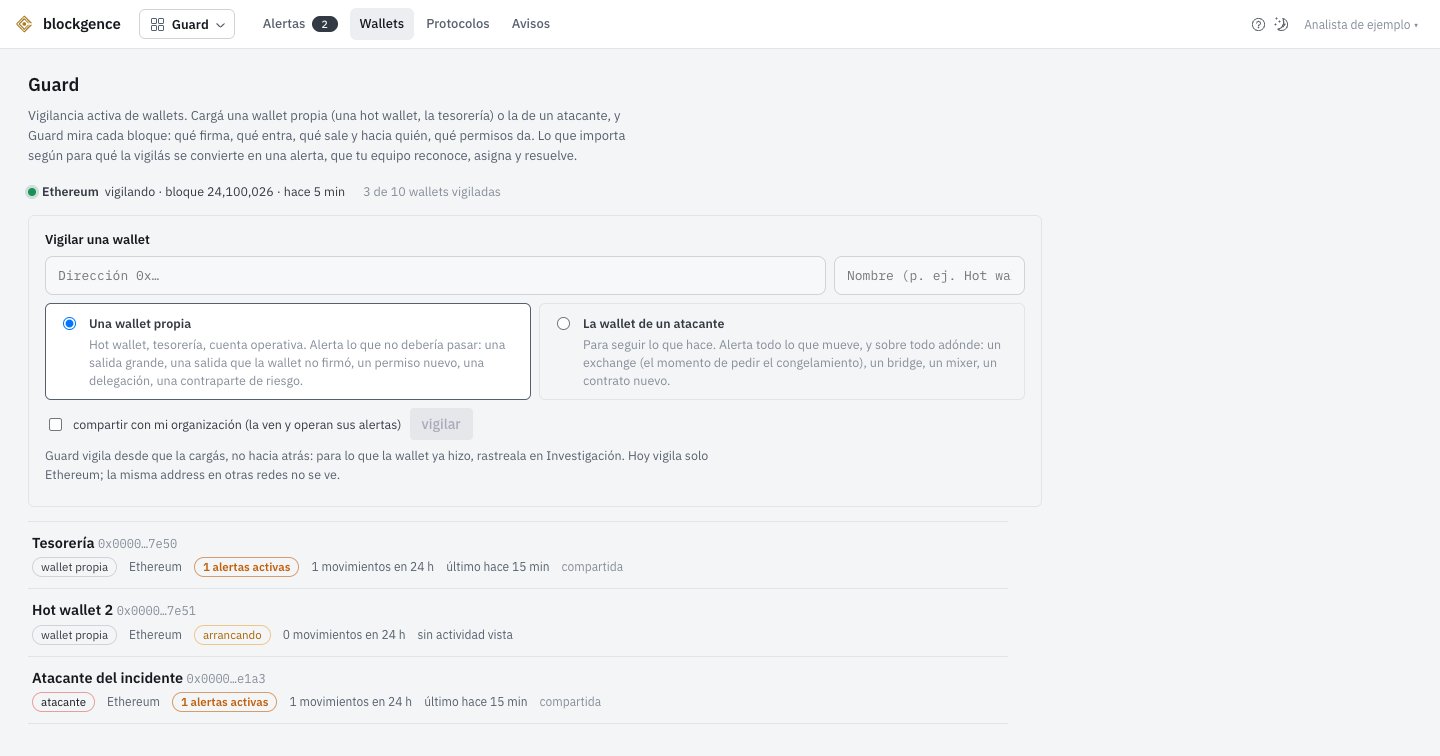
Watched wallets, with synthetic data.
Watch a wallet
1
Enter the address and the network
In Wallets, paste the address and pick the network. The top of the screen says which networks Guard watches and
whether the monitor is reading them.
2
Choose the purpose
Una wallet propia (own) or La wallet de un atacante (attacker’s). Each purpose comes with its default rules, which you can adjust later.
3
Share it, if you want
A shared watch is visible to your whole organization, and anyone who sees it can work its alerts.
What counts as activity
The transaction the wallet signs (even if it reverts), the native coin with its internal movements, ERC-20 tokens, ERC-721 and ERC-1155 NFTs, approvals (Permit2 included), EIP-7702 delegations (even when someone else submits them) and the contracts it creates. Each event is valued in USD, with the counterparty’s label. Noise is stored, marked, and does not alert: spam tokens, zero-value transfers (the signature of address poisoning), spoofed senders and dust.Rules
A transaction produces a single alert per watch, with the most severe rule and the list of every rule it triggered.
Follow the hops
On an attacker’s wallet, Seguir los saltos (follow the hops) makes Guard also watch the accounts it sends funds to, from US$1,000 accumulated per destination. That way the attacker does not get away by switching addresses. The derived watch inherits the rules, follows its own hops up to a depth of 2 (10 derived watches per tree, adjustable) and counts against your plan’s cap.It only follows into a regular account without a label. It does not follow into exchanges, bridges, routers, mixers,
contracts or EIP-7702 delegated accounts, and every cut is shown with its reason. An account that received the
attacker’s funds is not necessarily the attacker’s: the derived watch can be deleted.
Work the alerts
Each alert says what happened and where the funds went, with the transaction and the block. You reconocer (acknowledge), asignar (assign), resolver (resolve) with a reason or descartar (dismiss) it, and every change stays in its history. Abrir un caso en Investigación (open a case in Investigation) turns the alert into a case with the transaction’s graph, at no credit cost. If a reorganization drops the transaction from the chain, the alert is retracted (not deleted) and comes back if the transaction reappears.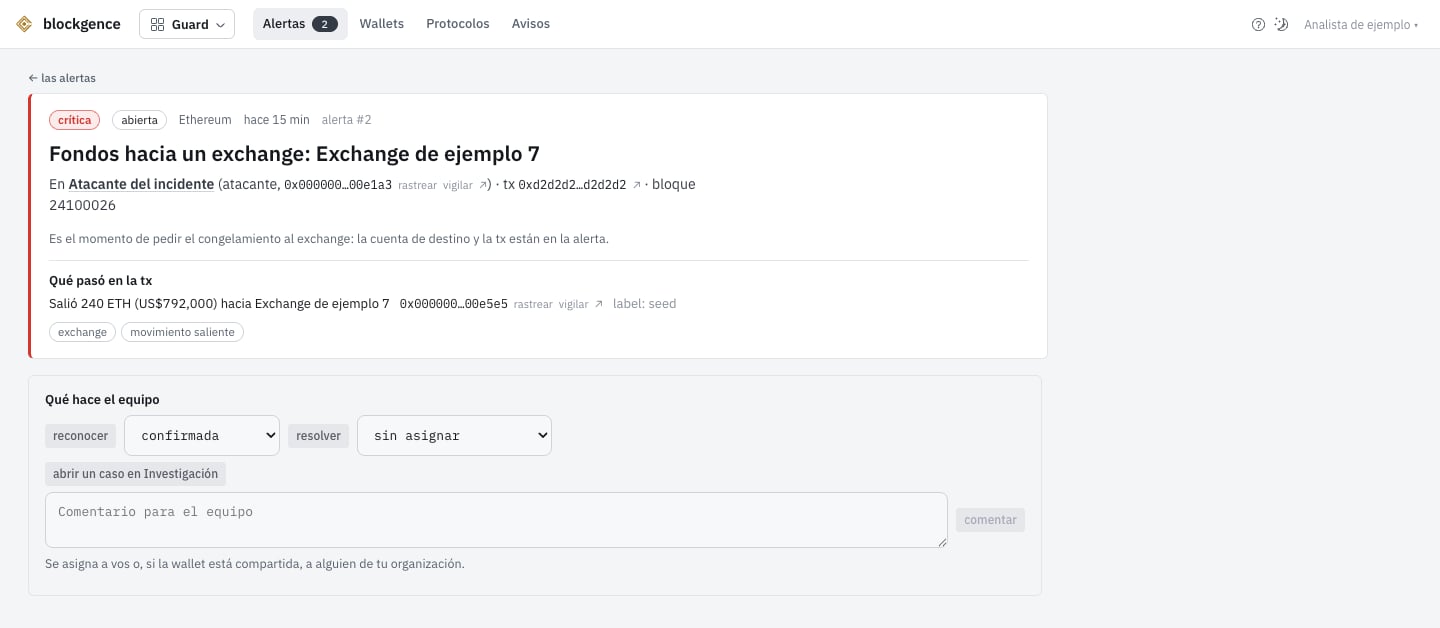
An alert, with synthetic data.
Notifications outside the app
- Signed webhook
- Email digest
One JSON POST per alert (new, retracted or back), signed with HMAC-SHA256 following Standard Webhooks, with one
secret per destination that can be rotated. The scope can be one watch, your watches or your organization’s shared
ones. Deliveries are retried for about 15 hours. From Avisos you can send a test and see the deliveries.
Watchtower: a protocol’s contracts
A protocol registers its contracts in Protocolos and Guard watches them with their own rules: a large net withdrawal per transaction in USD (default US$1,000,000), a change of owner, admin or admin role, a proxy upgrade, a pause, and two-step owner or admin transfers (it alerts on the proposal, before it is accepted). It also reads the events the protocol declares, and if its timelock or governor is registered, it says what a scheduled call would change before it runs.Watchtower is enabled per server. If it is not on, the Protocolos tab says so.
Through the API
The same features are under/v1/guard/*, with an API key assigned to a person (a key without an owner gets 403).
Guard does not charge credits: the cap is the number of watches in your plan.
What it does not cover
- It watches from the moment the wallet is added, not backward.
- Ethereum is read block by block. On Base, Optimism, Arbitrum, BSC and Polygon, when they are enabled, Guard reads the logs of the watched wallets: coverage is narrower, and whatever cannot be placed is declared per event.
- The false alert rate on real wallets is not measured.
- Watchtower only sees what the contract emits. The owner of a ProxyAdmin, the owner of a Safe or a beacon upgrade are left out unless those contracts are registered too, and the response declares it.
- Guard does not block transactions or revoke permissions: it alerts.